Benchmark · Lapas Core v1.1 vs Deepnest-next v1.5.6 · run v1_1-parity-flagfree
Half the offcut, from the same parts on the same plate.
Across ten published nesting instances, Lapas Core v1.1 leaves 13.9% of the plate as scrap. Deepnest-next v1.5.6 leaves 26.7%. On ten real sheet-metal jobs that is 25 plates instead of 28.
more of the plate thrown away by Deepnest (26.7% vs 13.9%)
saved across 10 real jobs, 25 against 28
Both engines get the same parts, the same plate and the same clock. Neither is trusted to grade its own work: a separate program recomputes every number from the output geometry.
By Rokas Slaboševičius, founder, Lapas run v1_1-parity-flagfree
Summary: Lapas Core v1.1 against Deepnest-next v1.5.6
Across 37 nesting cases measured on 24 July 2026, Lapas Core v1.1 packed tighter than Deepnest-next v1.5.6 on every one of the 10 ESICUP academic instances and used fewer or equal plates on all 10 sheet-metal jobs. Both engines received identical parts, identical plate sizes and identical wall-clock budgets, and all results were scored by an independent program.
- Material: Lapas Core v1.1 averaged 86.1% packing density against Deepnest-next v1.5.6 at 73.3% across the 10 ESICUP instances, a gap of 12.8 points, and won 10 of 10.
- Plates: on 10 synthetic sheet-metal jobs, Lapas Core v1.1 used 25 plates against Deepnest-next v1.5.6 at 28, saving a whole plate on 3 jobs and matching it on the other 7.
- Time: on all 4 instances tested, Lapas Core v1.1 reached a tighter nest in 10 seconds than Deepnest-next v1.5.6 reached in 5 minutes.
- Versus our own previous engine: 0 of 37 cases regressed on plates used against Lapas Core v1.0.31, and the 2000 part case improved by 1 plate.
12.8 points more of every plate becomes parts
Lapas Core v1.1 won all 10 ESICUP academic strip-packing instances, the standard yardstick in nesting research. It averaged 86.1% density against Deepnest-next v1.5.6 at 73.3%. Read as waste rather than yield, that is 13.9% of the plate scrapped against 26.7%. The gap ranges from 4.7 points on albano to 19.1 points on jakobs1.
These instances come from the published packing literature. We did not choose the shapes, which is the point of using them.
3 fewer plates across 10 real shop jobs
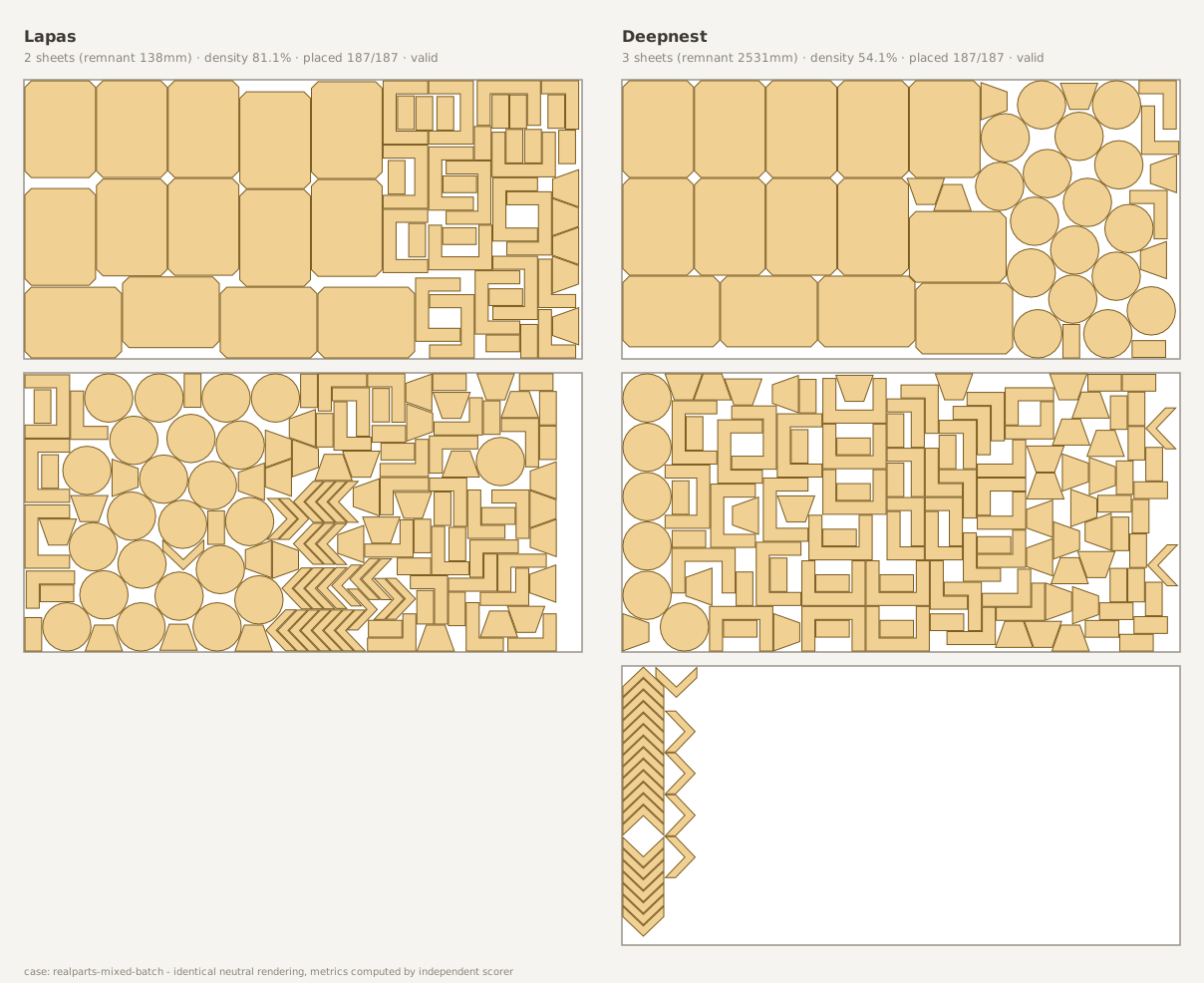
Ten sheet-metal jobs on a 3000 x 1500 mm plate: brackets, gussets, flanges, channels, tank panels. Density is the engine's metric, but plates consumed is the one that bills. Lapas Core v1.1 finished the batch on 25 plates against Deepnest-next v1.5.6 at 28: a whole plate saved on 3 jobs (chevrons, gussets-dense, mixed-batch) and an exact match on the other 7.
- chevrons 2 3 −1 plate
- gussets-dense 2 3 −1 plate
- mixed-batch 2 3 −1 plate
- brackets-mixed 3 3 identical
- channels 3 3 identical
- flanges 3 3 identical
- long-rails 3 3 identical
- plates-large 2 2 identical
- small-parts 3 3 identical
- tanks 2 2 identical
Batch total: 25 plates vs 28 (10.7% fewer)
10 seconds beats Deepnest's 5 minutes, on all 4 shapes
Each panel tracks how tight a nest Lapas Core v1.1 reaches as its budget grows from 10 seconds to 5 minutes. The dashed line is what Deepnest-next v1.5.6 achieved with the full 5 minutes. The Lapas curve starts above that line and stays above it, so the first ten seconds already beat the competitor's best run on the same shape.
Where Deepnest ties us, and what this test does not show
Deepnest matched us here
- On 7 of the 10 real jobs (brackets-mixed, channels, flanges, long-rails, plates-large, small-parts, tanks) both engines used exactly the same number of plates. Those jobs are plate-count ties, not wins.
- On 7 of those ties the density matched to within a rounding error, meaning both engines found effectively the same packing.
- Deepnest-next is free and open source. Lapas is a paid product. That is a real difference and it is not measured by any number on this page.
Limits of this benchmark
- We wrote the real-job and scale part mixes ourselves so the inputs could be published. Only the density and speed instances are third-party ESICUP shapes.
- We chose the plate sizes and the time budgets. They are identical for both engines, but they are our choices.
- Deepnest results in the scale suite are excluded: the recorded numbers are byte-identical to the Lapas run on 3 of 5 cases, which points to a fault in our harness rather than a real result. We would rather drop the suite than publish a number we do not trust.
- Nothing here measures cut-path time, common-line cutting, material cost or job setup effort.
This benchmark is published by Lapas, a vendor of one of the engines tested. The scorer is a separate program that reads only output geometry. Inputs, method and raw results are published so the run can be checked. Found a flaw in the method? Write to [email protected] and we will publish the correction.
One plate better at 2000 parts, nothing worse anywhere
Against our own previous engine, Lapas Core v1.0.31, the bar was set before the run: no case may use more plates, and no valid nest may turn invalid. 0 of 37 cases regressed, so the release shipped. The measurable gain is at the top end, where Lapas Core v1.1 nests 2,000 parts on 11 plates instead of 12, lifting density 5.9 points. On the ESICUP instances the two versions land within seed noise of each other (86.1% against 86.6% on average), so v1.1 holds that line rather than moving it.
| Parts | v1.0.31 plates | v1.1 plates | v1.1 density | Change |
|---|---|---|---|---|
| 50 | 1 | 1 | 19.6% | no change |
| 200 | 1 | 1 | 78.4% | no change |
| 500 | 3 | 3 | 65.3% | no change |
| 1,000 | 6 | 6 | 65.3% | no change |
| 2,000 | 12 | 11 | 71.3% | −1 plate |
Full results: all 37 cases, nothing withheld
Every case that ran, including the ones where Lapas Core v1.1 came out behind its predecessor. Headline metric is plates for the real-job and scale suites and density for the academic and speed suites. Green marks a gain over Lapas Core v1.0.31, amber a loss, grey a dead heat inside seed noise.
| Suite | Case | v1.1 | v1.0.31 | Deepnest | vs v1.0.31 |
|---|---|---|---|---|---|
| Density | density-albano | 87.9% | 87.8% | 83.2% | +0.1 pt |
| Density | density-dagli | 87.2% | 86.3% | 73.9% | +0.9 pt |
| Density | density-fu | 89.7% | 91.4% | 78.1% | -1.7 pt |
| Density | density-jakobs1 | 89.1% | 89.1% | 70.0% | -0.0 pt |
| Density | density-jakobs2 | 80.4% | 83.6% | 64.3% | -3.2 pt |
| Density | density-mao | 84.0% | 84.6% | 78.6% | -0.6 pt |
| Density | density-marques | 89.6% | 88.8% | 74.8% | +0.8 pt |
| Density | density-shirts | 88.3% | 87.7% | 72.4% | +0.6 pt |
| Density | density-swim | 75.1% | 76.8% | 65.9% | -1.8 pt |
| Density | density-trousers | 90.1% | 90.2% | 72.0% | -0.1 pt |
| Real jobs | realparts-brackets-mixed | 3 sh | 3 sh | 3 sh | 0 |
| Real jobs | realparts-channels | 3 sh | 3 sh | 3 sh | 0 |
| Real jobs | realparts-chevrons | 2 sh | 2 sh | 3 sh | 0 |
| Real jobs | realparts-flanges | 3 sh | 3 sh | 3 sh | 0 |
| Real jobs | realparts-gussets-dense | 2 sh | 2 sh | 3 sh | 0 |
| Real jobs | realparts-long-rails | 3 sh | 3 sh | 3 sh | 0 |
| Real jobs | realparts-mixed-batch | 2 sh | 2 sh | 3 sh | 0 |
| Real jobs | realparts-plates-large | 2 sh | 2 sh | 2 sh | 0 |
| Real jobs | realparts-small-parts | 3 sh | 3 sh | 3 sh | 0 |
| Real jobs | realparts-tanks | 2 sh | 2 sh | 2 sh | 0 |
| Speed | speed-albano-10s | 87.2% | 87.2% | 78.7% | +0.0 pt |
| Speed | speed-albano-30s | 87.4% | 87.6% | 82.4% | -0.1 pt |
| Speed | speed-albano-60s | 87.7% | 87.5% | 82.8% | +0.2 pt |
| Speed | speed-shirts-10s | 84.9% | 85.9% | 70.2% | -1.0 pt |
| Speed | speed-shirts-30s | 86.1% | 86.3% | 71.2% | -0.2 pt |
| Speed | speed-shirts-60s | 87.2% | 87.0% | 71.4% | +0.2 pt |
| Speed | speed-swim-10s | 71.9% | 72.1% | 61.7% | -0.2 pt |
| Speed | speed-swim-30s | 73.8% | 73.5% | 65.8% | +0.3 pt |
| Speed | speed-swim-60s | 73.7% | 74.7% | 65.8% | -1.0 pt |
| Speed | speed-trousers-10s | 87.7% | 88.8% | 68.0% | -1.1 pt |
| Speed | speed-trousers-30s | 88.8% | 89.2% | 69.3% | -0.4 pt |
| Speed | speed-trousers-60s | 89.1% | 89.7% | 71.4% | -0.6 pt |
| Scale | scale-1000 | 6 sh | 6 sh | not run | 0 |
| Scale | scale-200 | 1 sh | 1 sh | not run | 0 |
| Scale | scale-2000 | 11 sh | 12 sh | not run | -1 |
| Scale | scale-50 | 1 sh | 1 sh | not run | 0 |
| Scale | scale-500 | 3 sh | 3 sh | not run | 0 |
Density and speed cases run three seeds and report the median, so a change under 0.75 points counts as a dead heat. Plate counts are integers, so any change there is real. Deepnest is marked "not run" in the scale suite for the reason given above.
Questions about this benchmark
Is Lapas better than Deepnest for nesting?
On material yield, yes, by a measured margin. Across 10 ESICUP academic instances Lapas Core v1.1 averaged 86.1% packing density against Deepnest-next v1.5.6 at 73.3%, and it won every instance. On 10 sheet-metal jobs it used 25 plates against 28. Deepnest-next is free and open source, which Lapas is not, so the comparison is not one-dimensional.
How much material does Lapas actually save?
On the academic instances Lapas Core v1.1 leaves 13.9% of the plate as offcut where Deepnest-next v1.5.6 leaves 26.7%, so Deepnest discards 1.92 times as much. On the ten real sheet-metal jobs the saving was 3 plates out of 28, or 10.7%. Your own saving depends on your parts, so the honest way to find it is to run your own DXF files.
Is Lapas faster than Deepnest?
It reaches a better nest sooner. On all 4 instances tested, the nest Lapas Core v1.1 produced in a 10 second budget was tighter than the one Deepnest-next v1.5.6 produced with a full 5 minutes on the same shape.
Can I reproduce this benchmark?
The scored results are published as JSON and CSV under CC BY 4.0. The density and speed shapes are the public ESICUP instances, so anyone can run them against either engine. Deepnest-next v1.5.6 is open source and was run headless with default settings.
Who scored the results?
A separate program, not either engine. It reads the output geometry, recomputes density, plate count and remnant from scratch, and checks that no parts overlap and that spacing rules hold. A run that fails validation is discarded rather than scored.
Which cases did Lapas not win?
Against Deepnest-next v1.5.6, 7 of the 10 real jobs were exact plate-count ties: brackets-mixed, channels, flanges, long-rails, plates-large, small-parts, tanks. Against our own previous engine, Lapas Core v1.0.31, several density and speed cases came out slightly lower, all inside seed-to-seed noise, and they are listed in the full results table above.
How we tested
Methodology
Every case feeds identical inputs to each engine: the same parts, the same plate size and the same wall-clock budget. Deepnest runs as deepnest-next v1.5.6 headless with default settings; Lapas runs Lapas Core v1.1 headless. Runs were executed on one machine under Windows 11 Pro.
No engine grades its own work. A separate scorer reads each run's output geometry, recomputes density, plate count and remnant from scratch, and validates that no parts overlap and that spacing rules hold. A run that fails validation does not count.
Density and speed suites use the public ESICUP irregular packing instances (Albano, Dagli, Fu, Jakobs, Mao, Marques, Shirts, Swim, Trousers) used throughout the cutting and packing literature. Real-job and scale suites use synthetic sheet-metal jobs written for this benchmark so the inputs can be published openly. Academic and real-job cases run three seeds and report the median.
Density is defined as placed part area divided by used plate area. Renders on this page are drawn by the scorer in one neutral style for both engines, so the picture is the geometry that was measured, not an illustration.
- Cases
- 37
- Run
- v1_1-parity-flagfree ·
- Lapas engine
- Lapas Core v1.1
- Competitor
- deepnest-next v1.5.6
- Previous engine
- Lapas Core v1.0.31 · 2026-06
- Hardware
- Not recorded for this run. Both engines ran on the same machine under identical wall-clock budgets, so the head-to-head comparison holds, but absolute timings are not reproducible from this page alone. To be fixed on the next run.
Deepnest is an independent open-source project. Lapas is not affiliated with, endorsed by or sponsored by Deepnest or its contributors. Deepnest-next v1.5.6 was tested as released, with default settings, in July 2026.
Related research: this page measures engines on test instances. The Nesting Utilization Report 2026 measures what shops actually get, across 6,900 completed jobs, with the row data published under CC BY 4.0.
Don't take our word for it.
Upload one of your own DXF files and see the layout yourself. It's free and takes about two minutes.
On a phone? Book a 20-minute call and we nest your file with you on a screen share.
No credit card · No install · Your files stay yours
Free · 20 minutes · No commitment