Cost justification
The ROI of nesting software, calculated properly
If you are building a case for someone who signs off on spend, you need three numbers and one of them is uncomfortable: what your utilization is today. Most shops do not measure it, and every vendor benefits from that.
The short version
Nesting software pays back fast if you currently lay parts out by hand or with rectangular bounding boxes, because the space inside concave shapes is pure waste. It pays back slowly or not at all if you already run a good true-shape nester, and swapping between two good nesters is usually not a business case. The deciding factor is what you do today, not which product you buy.
The formula
Worked example, with the inputs shown so you can disagree with them: a shop spending $6,000 a month on sheet, currently at 68% utilization, reaching 86%. That is 6000 × (0.86 − 0.68) ÷ 0.86 = $1,256 a month.
Those are illustrative inputs, not a promise. Change them to yours below. And note what the formula does not include: operator time, remnant handling, scrap value and machine time per sheet. On low-volume work the time saved is often worth more than the material, and it is the first thing left out of a business case because it is harder to defend.
ROI calculator
How much is waste costing your shop?
Move the sliders. See what you could save each month.
A real job at your volume
Steel fabrication, Spain put 180 parts on 4 plates instead of 6, using 92% of every plate, in 35 seconds.
Assumes optimized utilization reaches 85%, in line with the customer jobs shown above and in the panel. Actual savings depend on part complexity, material type, and operator method.
Where our numbers come from, and where they stop
Most nesting vendors will quote you a utilization figure with nothing behind it. Ours is published: Lapas Core v1.1 against deepnest-next v1.5.6 over 37 cases, three seeds each, identical parts, plates and time budgets, scored by a program that is not part of either engine, released under CC BY 4.0.
It says 86.1% average packing density against 73.3% on the ten ESICUP academic instances, and 25 plates against 28 across ten sheet-metal jobs. It also says the two tie on 7 of those 10 real jobs. That last number is the one to take into a business case, because it is the honest ceiling: against a competent true-shape nester the gain is often nothing, and the case has to be made against what you actually do today.
Note also that this benchmark did not record its hardware, so the timing comparisons in it are relative rather than reproducible. We would rather say that than have you find it.
Independently benchmarked
Measured against Deepnest, not just claimed
We ran Lapas Core v1.1 head to head against Deepnest on 37 nesting cases: same parts, same plates, same time budgets, then scored every result with an independent program that reads the output geometry. On the standard density tests Lapas left 13.9% of the plate as offcut against Deepnest's 26.7%, and on real jobs it fits the same parts on fewer plates. Fewer plates means lower material spend on every run.
Read the full benchmark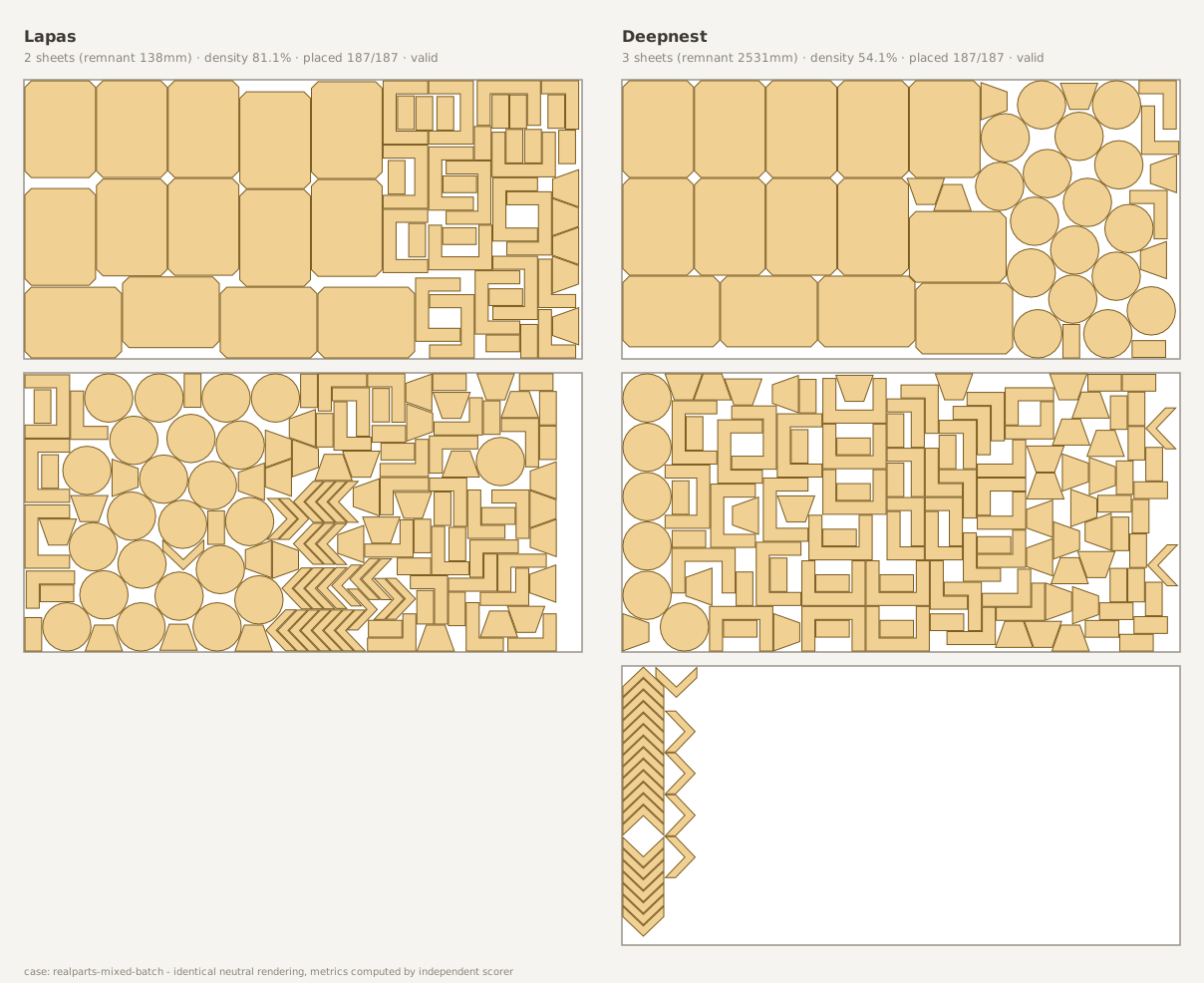
Same 187-part job: Lapas fits 2 plates (left); Deepnest needs 3 (right).
- 1.92x
- more of the plate thrown away by Deepnest: 26.7% wasted against our 13.9%
- 10 s
- beats Deepnest's best 5-minute nest, on every shape tested
- 3 plates
- saved across a 10-job batch, 25 against 28, never more
The cheapest way to settle it
Take a job you have already cut and know the sheet count for. Nest it on the free plan, which needs no card, and compare. One real job against your own historical numbers is worth more than any calculator on any vendor's website, including the one above. If it does not beat what you did, you have your answer and it cost you twenty minutes.
Nest one real job, freeCommon questions
It is material saved minus what the software costs, and the honest answer is that it depends entirely on how you nest today. A shop laying parts out by eye or with rectangular bounding boxes has a lot to gain from true-shape nesting. A shop already running a good true-shape nester has very little, and swapping tools will not pay back. The number that matters is your current utilization, and most shops do not know it.
Take monthly sheet spend, your current utilization percentage, and the utilization you would reach. Saving equals monthly spend multiplied by the difference divided by the new figure. The calculator on this page does it. If you do not know your current utilization, measure it before believing any vendor including us: total part area divided by total sheet area consumed over a month.
Against manual or rectangular layout, moving into the mid to high 80s is normal on irregular parts, because bounding boxes waste the space inside concave shapes. Against a good true-shape nester, expect little or nothing. Our own published benchmark ties deepnest-next on 7 of 10 real sheet-metal jobs, and we would rather you saw that than a marketing number.
The free plan is $0 with no expiry and no credit card: unlimited nesting and re-nesting, no cap on parts per job, and 5 project exports a month in any format. Pro removes the export cap at $49 a month, or $39 a month billed annually which is $468 a year. That means the payback threshold for Pro is roughly $49 of material a month, which most shops clear on a single sheet.
Do not lead with a vendor estimate. Nest one real job that you have already cut, compare the sheet count against what you actually used, and put that single number in front of them. It costs nothing on the free plan and one real job is more persuasive than any calculator, including the one on this page.
Time. If nesting currently takes an operator twenty minutes a job and it drops to two, that is usually worth more than the material on low-volume work. It is also harder to defend in a business case, so it tends to get left out. Remnant handling, scrap value and machine time per sheet are the other three commonly omitted.
Material is one half of the case. The other half is the quote clock, and the quote speed benchmark guide works through what turning quotes around faster is worth in jobs won per year.
Related: the full benchmark, pricing, and how this fits alongside your ERP.
Don't take our word for it.
Upload one of your own DXF files and see the layout yourself. It's free and takes about two minutes.
On a phone? Book a 20-minute call and we nest your file with you on a screen share.
No credit card · No install · Your files stay yours
Free · 20 minutes · No commitment