FABTECH 2026 Takeaways for Laser and Plasma Shops: What It Means for Nesting
FABTECH 2026 in Las Vegas was about AI and automation, driven by rising material costs, too few skilled workers and faster turnaround. What it means for nesting, and five questions to ask before choosing nesting software.
Short version: FABTECH 2026 (Las Vegas, October 21–23) was about AI and automation, but the pressures behind it were plainer: rising material costs, too few skilled workers, and customers who want parts in days, not weeks. For shops that cut sheet metal, that puts the spotlight on two things: how much material each sheet wastes, and how many hours it takes to get a program onto the machine. Big nesting vendors are answering with suites and AI copilots. Smaller shops should start with a simpler question: will this run on my machine?
This article is based on organizer materials, exhibitor announcements, trade press, and what we learn from cutting shops that try Lapas. Sources are listed at the end.
FABTECH 2026 in numbers
| Item | Detail |
|---|---|
| Dates | October 21–23, 2026 |
| Venue | Las Vegas Convention Center, the first Las Vegas edition in a decade |
| Scale (organizer figures) | 1,400 exhibitors, 700,000+ sq ft, 40 product categories, 180+ conference sessions |
| New in 2026 | An AI for Manufacturing pavilion and a premium “FAB Pass” tier |
| Audience | Job shop owners, plant managers, manufacturing engineers, production supervisors, equipment buyers |
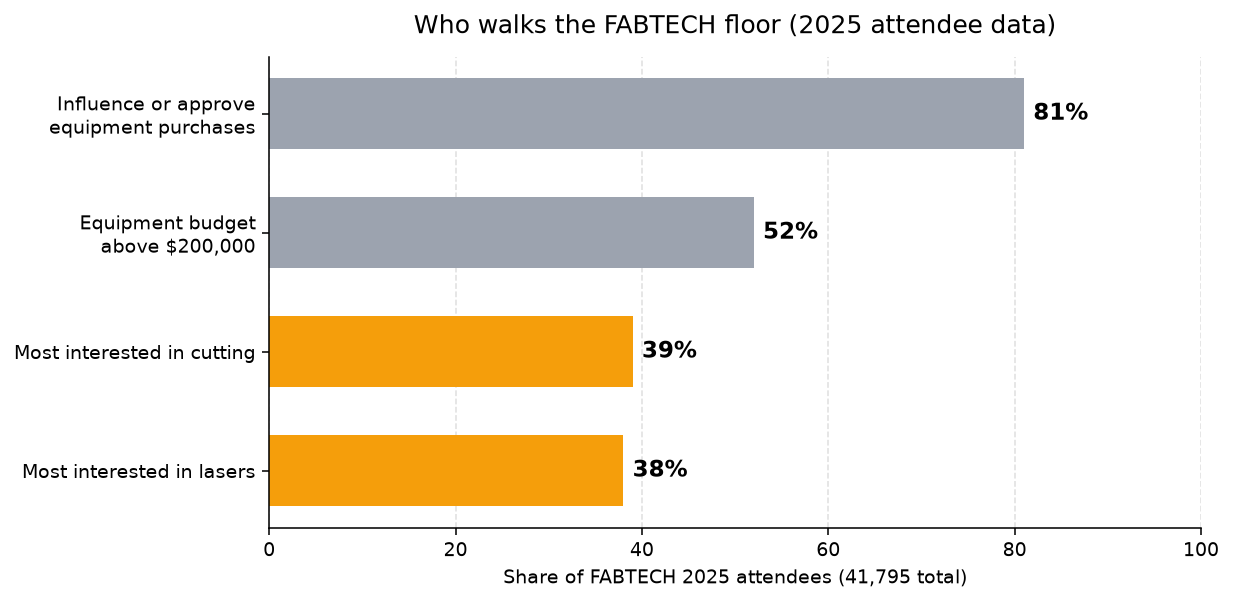
Last year’s show gives a useful picture of who walks the floor. FABTECH 2025 in Chicago reported 41,795 attendees; 81% said they influence or approve equipment purchases, 52% had equipment budgets above $200,000, and cutting (39%) and lasers (38%) were the two technologies they were most interested in.
A decade ago it was cloud software and cobots
The Fabricator’s preview of the show looked back at 2016, the last time FABTECH was in Las Vegas. Back then, exhibitors were showing off the promise of additive manufacturing, software developers were “hyping the potential of cloud-based computing”, and a small piece of automation called the collaborative robot was a novelty. Those were the big developments of the moment.
Ten years later the technologies have moved from promise to routine, and the new headline is AI. The same article describes where the pull comes from: data-center construction for AI has created demand with a long supply chain, from computer racks to power generation, and the companies funding it are willing to pay for parts and assemblies completed in days instead of weeks. Aerospace and defense spending remains up, while more traditional sectors such as agriculture and recreation struggle. In other words, an uneven recovery, with some customers asking for much faster turnaround than before.
Four pressures behind the show
1. Fewer people. Organizers cite an American Welding Society estimate that the industry is short around 400,000 workers. Programming and nesting are exactly the kind of work that sits with one experienced person in many shops, and when that person is busy or leaves, jobs wait.
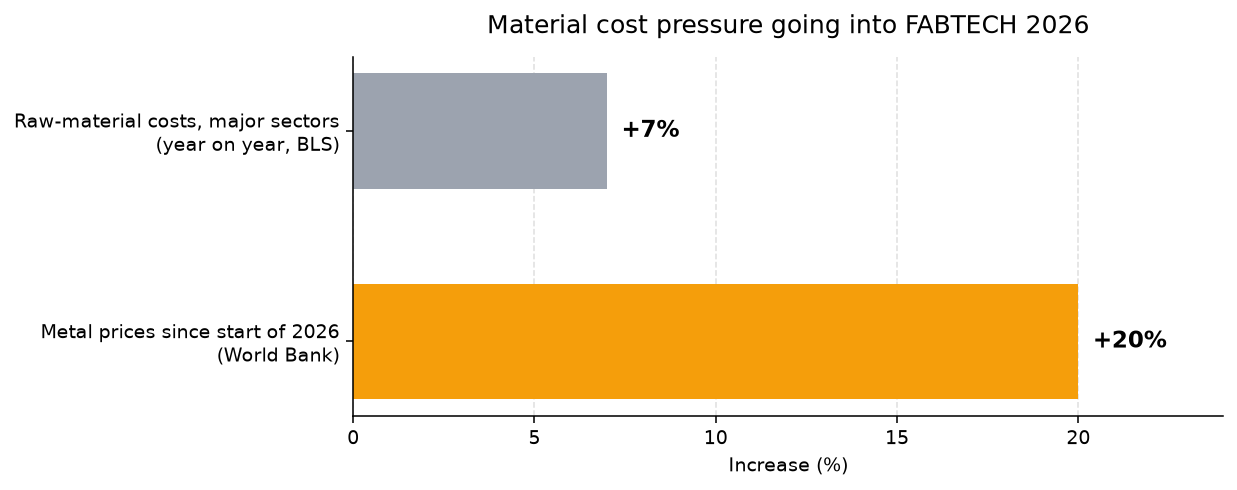
2. Rising material cost. According to the organizers’ pre-show release, raw-material costs for major sectors rose 7% year on year (Bureau of Labor Statistics), and the World Bank reported metal prices up 20% since the start of the year. When steel and aluminum cost more, scrap stops being a rounding error. A few percent on a sheet is now a visible number on the quote.
3. Faster turnaround. When customers expect parts in days, the time between receiving a drawing and having a program on the machine becomes part of what you sell. The Fabricator’s preview notes that many fabricators are looking for machinery and software that help them get more out of the workforce they already have, by automating repetitive work and moving people to better tasks.
4. Tariffs and reshoring. Domestic job shops are being asked to take on more work. That means more mixed jobs, shorter runs and more quotes to price quickly. The executive panel on the opening day put exactly these topics on the table: capital investment priorities, technology adoption, workforce strategy and supply chain risk.
The AI question, and why it was really about data
A debut AI pavilion made AI the headline, but the more interesting thing was how the conversation shifted. One exhibitor reported that by day two the question at their booth was no longer “what can your AI do?” but “how do we prepare for what’s next?” Citing a session by Paul Farrell, they put it this way: “your AI is only as smart as your shop.” In other words, a system can only recommend something useful if it is fed true information about stock, jobs and machines.
The conference program reflected the same thing: sessions on data and AI readiness, AI for high-mix low-volume work, and getting started with AI “from first steps to scale”. Trade press was also careful. One FABTECH preview noted that being listed in the AI pavilion does not by itself mean an exhibitor has a production-ready AI product, and suggested buyers ask whether the system copes with imperfect drawings and missing data, who approves its recommendations, and whether the vendor can show a comparable factory.
That is good advice for any software purchase, nesting included.
What the big nesting vendors announced
The established names are widening from “nesting” to “connected shop”:
SigmaTEK (formerly SigmaNEST). The company renamed itself on October 12, now part of Sandvik, and showed V27 with a Copilot that turns plain-language requests into actions such as importing parts, nesting jobs, posting programs and running reports. It positions nesting as one part of a suite that also covers quoting, production and analytics. (How it compares: SigmaNEST alternatives.)
Lantek. Showed its v46 sheet metal software, combining quoting, engineering, CAD/CAM and connected production, alongside its KAI AI program.
Hypertherm. ProNest CAD/CAM nesting appeared next to new plasma and waterjet hardware. (How it compares: ProNest alternatives.)
Libellula / NestSoft US. Programming and material-utilization software, with LIA, its AI project.
RADAN (Hexagon), Bystronic BySoft, TCI Cutting / FST and newer entrants such as Fabricator-AI also exhibited software for cutting workflows.
The direction is clear: suites, ERP links and AI assistants. For a large manufacturer with an ERP and a dedicated programming department, that makes sense. For a small or mid-sized cutting shop, the priorities are usually simpler: get from a customer’s file to a clean program quickly, and waste as little sheet as possible. If you are comparing options, our guide to the best nesting software in 2026 puts free and paid tools side by side.
Five questions to ask before choosing nesting software
The tooling is changing fast, but these questions have not changed:
Will it run on my machine? Nesting only saves money if the program reaches the cutter. Ask whether the software can generate G-code for your exact controller, whether you need a post-processor, and who builds it.
Can I test it on my own job? A demo with the vendor’s parts proves little. Use your real files, your material and your kerf, and compare against what you do today.
What happens to the leftovers? Remnants are worth money. Check whether the software can reuse partial sheets, and how it handles sheets with damaged or unusable areas.
Who stays in control? Whether a feature is “AI” or not, you should be able to see the result, move a part, and override it before cutting.
How much do I have to commit, and how fast can it be changed? Ask what happens when your machine, material or workflow changes, and how long a fix takes.
The best test is the dull one: bring a real job and a real program from your machine, and compare the result with what you do today.
— Rokas Slaboševičius, Founder, Lapas
The part people forget: the post-processor
“Better nesting” is rarely the whole story. The real question is the machine: a nest that cannot be turned into a clean program for your controller is just a nice picture. That is why we think the quiet question (does the output actually run on my cutter?) matters more than any AI feature on a stand. Before you commit to any tool, check which software and machine setups it already works with.
When a shop writes to us, the first question is almost never about nesting quality. It’s whether the program will run on their machine. So we ask for one real program from that machine and work from there.
— Rokas Slaboševičius, Founder, Lapas
Where Lapas fits, and where it does not
Lapas is a browser-based nesting tool for laser and plasma shops. You upload your parts (DXF, DWG, SVG, PDF and more), set the sheet, nest in the browser and export. Since version 2.0 (September 2026) you can save your own machines and check G-code or PLT output against their rules before it goes to the cutter. It is meant for anyone who cuts from sheet, from metal to wood and other materials. The full list of releases is on the what’s new page.
Lapas doesn’t replace your CAM. It helps a shop get from a customer’s file to a cuttable job faster.
— Rokas Slaboševičius, Founder, Lapas
We are not the right choice for everyone. If you already run a full CAD/CAM and ERP suite with a team that maintains it, a browser tool is not going to replace that. And nesting results differ between programs and jobs, so we encourage you to compare on your own parts rather than trust any claim, ours included. If you want to see whether it fits your machine, book a setup call and bring one of your jobs.
What to take from FABTECH 2026
- The pressure is real: fewer people, higher material cost, more mixed work.
- AI is moving into every layer, but trade press is reminding buyers to ask for evidence.
- Large vendors are building suites. Smaller shops still win or lose on the basics: output that fits the machine, a fair test, and sensible use of leftover sheet.
- If you only have an hour for software evaluation, spend it on the five questions above.
FABTECH returns to Chicago’s McCormick Place on September 13–16, 2027.
FAQ
What is nesting software?
Nesting software arranges parts on a sheet so you use less material, and prepares the cutting path for the machine. Good nesting reduces scrap and programming time; the output still has to be a program your machine can run.
Does nesting software work with any CNC machine?
Only if it can produce code for your controller. That usually means a post-processor for your specific machine. It is the first thing to confirm before buying.
What changed in nesting software in 2026?
Major vendors added AI assistants and joined nesting to quoting, production and ERP tools. SigmaNEST became SigmaTEK with a built-in Copilot, and Lantek introduced v46 with its KAI AI program.
Do I need AI in nesting software?
Not necessarily. What you need is a result you can check and change, output that runs on your machine, and a way to test it on your own jobs before committing.
How do I compare nesting programs fairly?
Use the same parts, the same sheet, the same gap and the same machine settings in each. Compare sheets used, leftover size and time to a runnable program, not marketing claims. Our benchmarks page shows how we test.
What is FABTECH?
FABTECH is North America’s largest metal forming, fabricating, welding and finishing trade event, organized by AWS, FMA, PMA, SME and industry partners. The 2026 edition ran October 21–23 in Las Vegas.
Sources
- FABTECH 2026: A lot has changed in 10 years, The Fabricator (September 17, 2026)
- FABTECH 2026 show floor highlights major manufacturing investments, Canadian Metalworking (October 1, 2026)
- FABTECH 2026 pre-show release (September 30, 2026)
- FABTECH, AI for Manufacturing pavilion
- FABTECH 2026 Las Vegas Sneak Preview, Fabricating & Metalworking
- FABTECH Manufacturing Technology Takes Center Stage in 2026, Fabricating & Metalworking
- FABTECH 2026 AI exhibitors guide, MachineToolNews.ai (October 9, 2026)
- FABTECH U.S.A. 2026 event information incl. 2025 attendee data, Expometals
- SigmaNEST Company Becomes SigmaTEK (October 2026)
- Lantek at FABTECH USA 2026
- Exhibitor posts and FABTECH social channels (LinkedIn, Instagram), October 21–23, 2026
Try Lapas free
The free plan needs no credit card and no install. Start nesting in 60 seconds.
Nest my first sheetBook a call